The starting situation
An energy-audit consultancy with no visibility in a market where the demand already exists: owners, building associations and business premises look for an auditor near them and land on national platforms that resell the contact.
What was delivered
A site built to be found, and an advertising setup that feeds it while organic search settles in. Enquiries arrive already qualified by a funnel questionnaire, land in a back office where they're sorted, and each one knows which ad and which keyword it came from.
What it changes
The project as the people using it every day see it.
01
Visible in its own area, not nationally
One page per Île-de-France department, each with its own content. An owner in Essonne is looking for an auditor in Essonne, not a middleman in Paris.
02
Enquiries that arrive already qualified
Property type, floor area, year built, heating, occupancy status, town: all of it is filled in before the first call. The quote gets prepared instead of discovered.
03
No enquiry lost
Every submission is recorded before the email is even attempted. A mail outage no longer costs a customer.
The screens, one by one
Each capture stays put while you read what it demonstrates, and each is paired with its phone version.
01 / 04
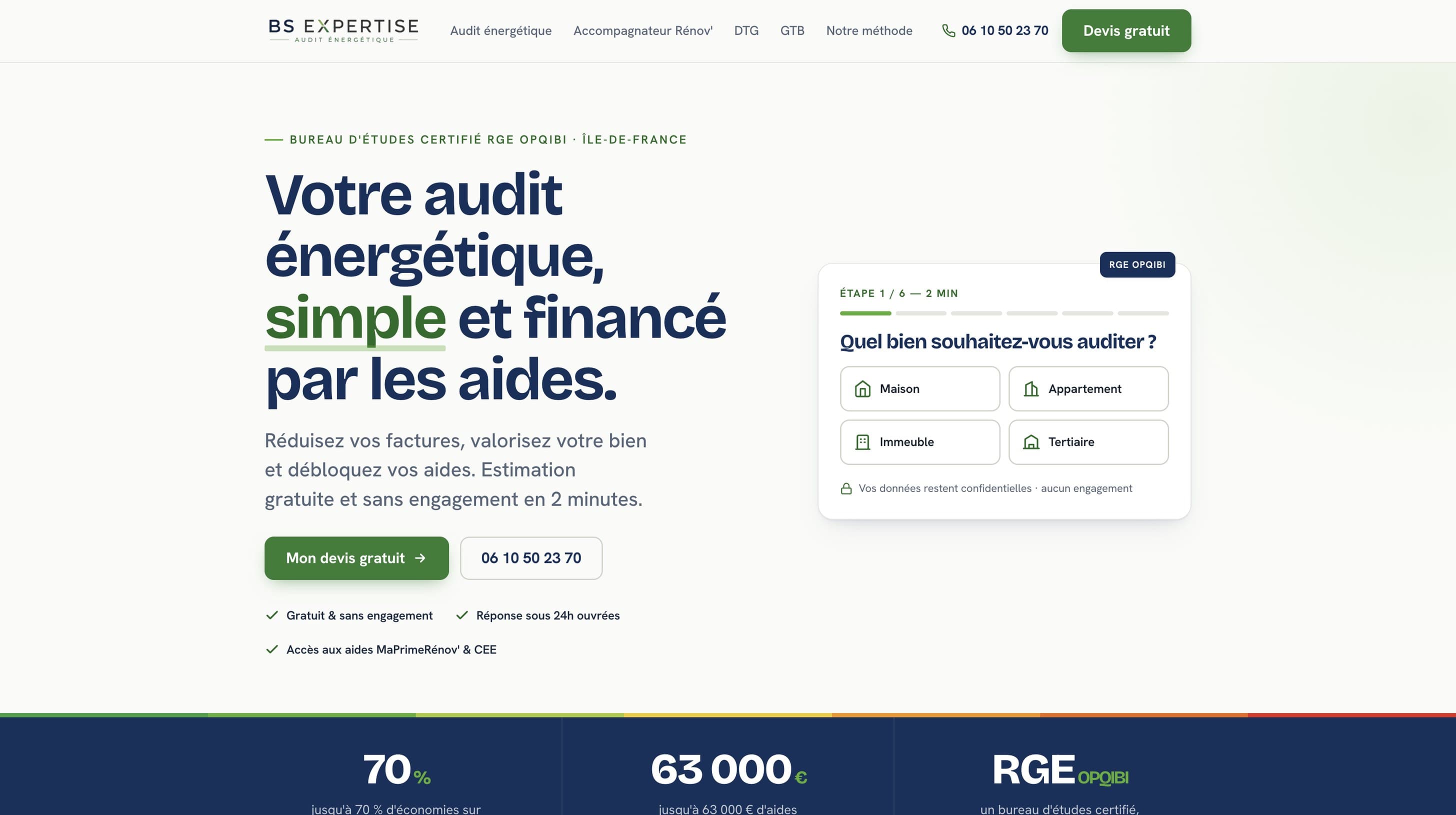
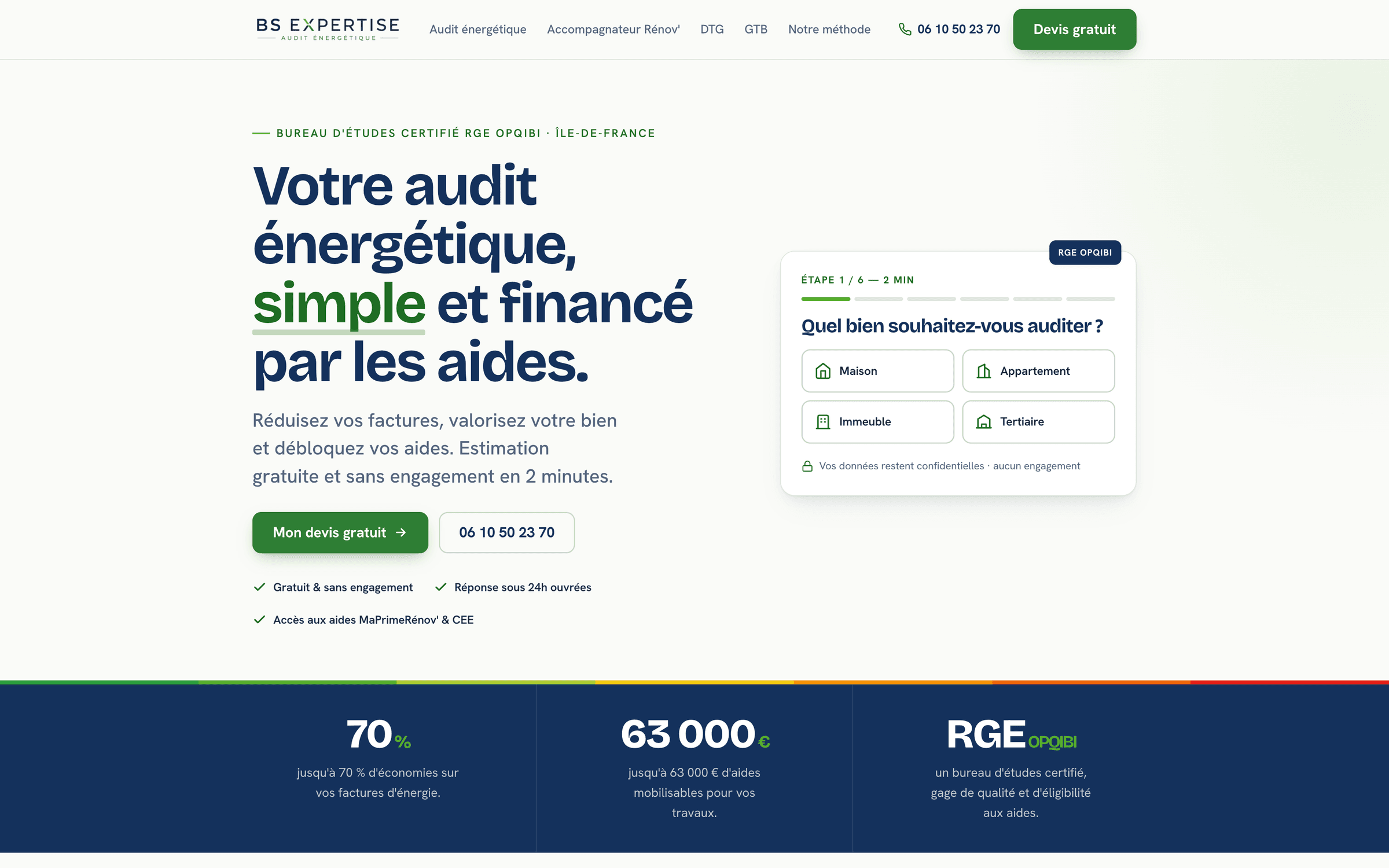
The questionnaire starts on the homepage
The first question of the quote is already on the landing page: property type, in one click. Visitors aren't asked to go and find a form, they take the first step where they already are.
Under the hood
The funnel is a state machine shared between the homepage panel and the dedicated page: starting in either place leads to the same journey, without losing the answer already given.
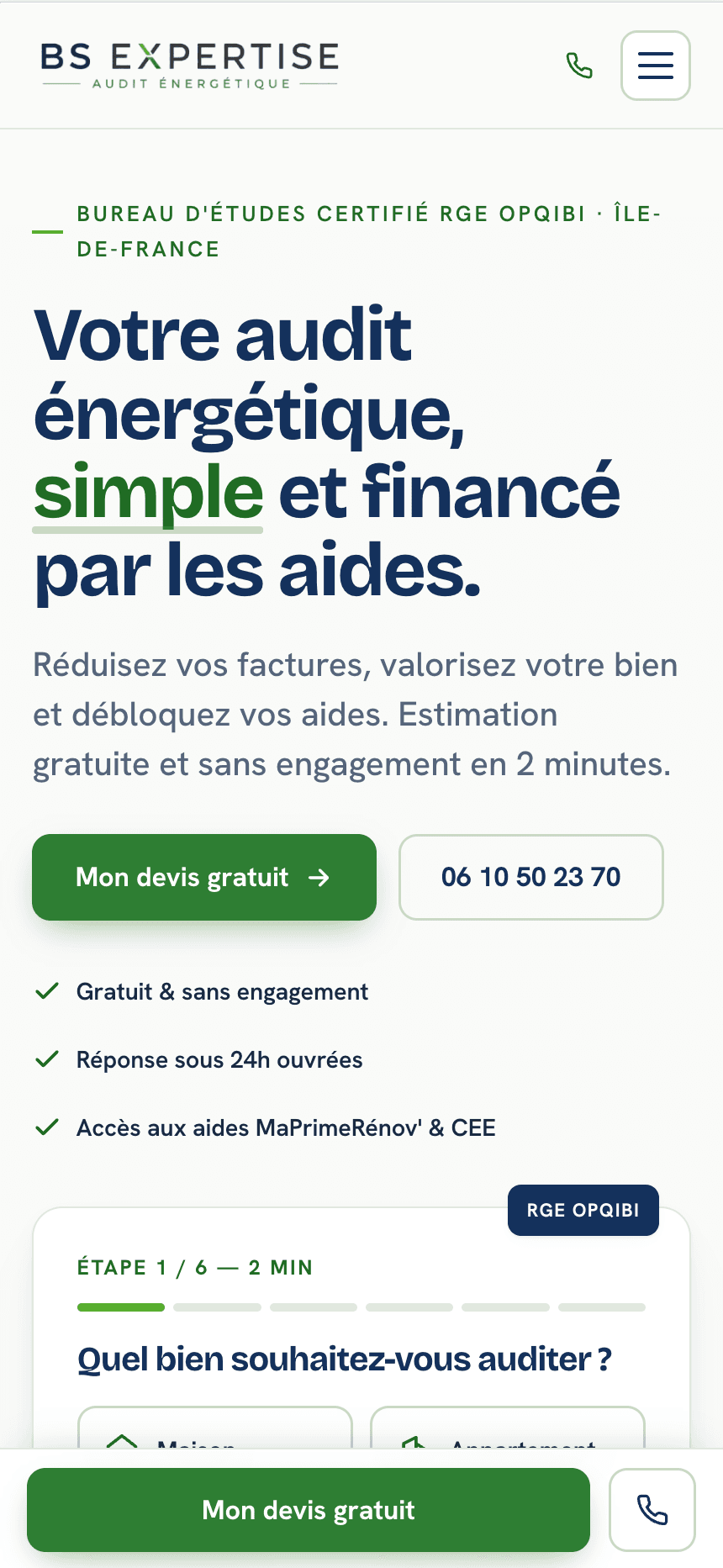
On a phone
The panel moves below the headline and a call bar stays pinned to the bottom of the screen, within thumb reach.
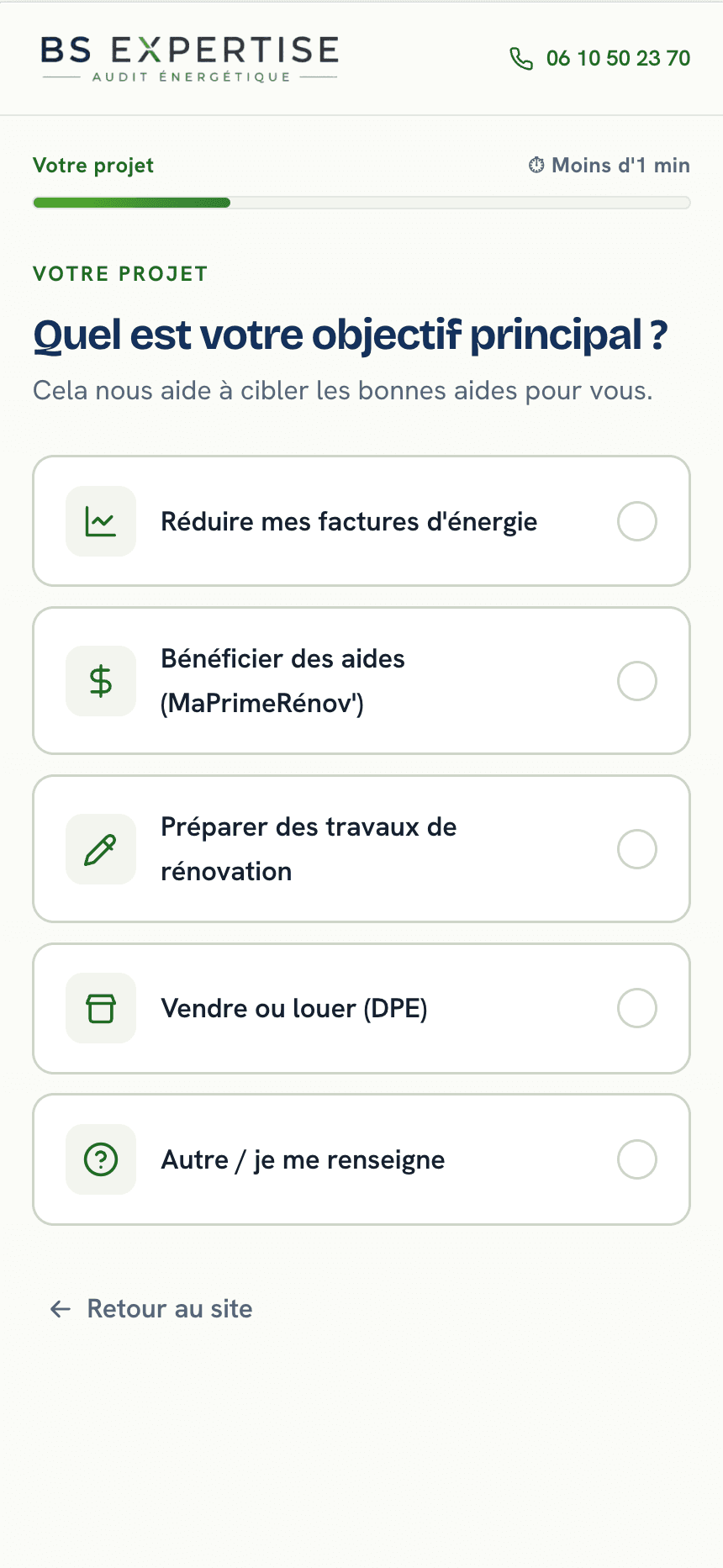
02 / 04
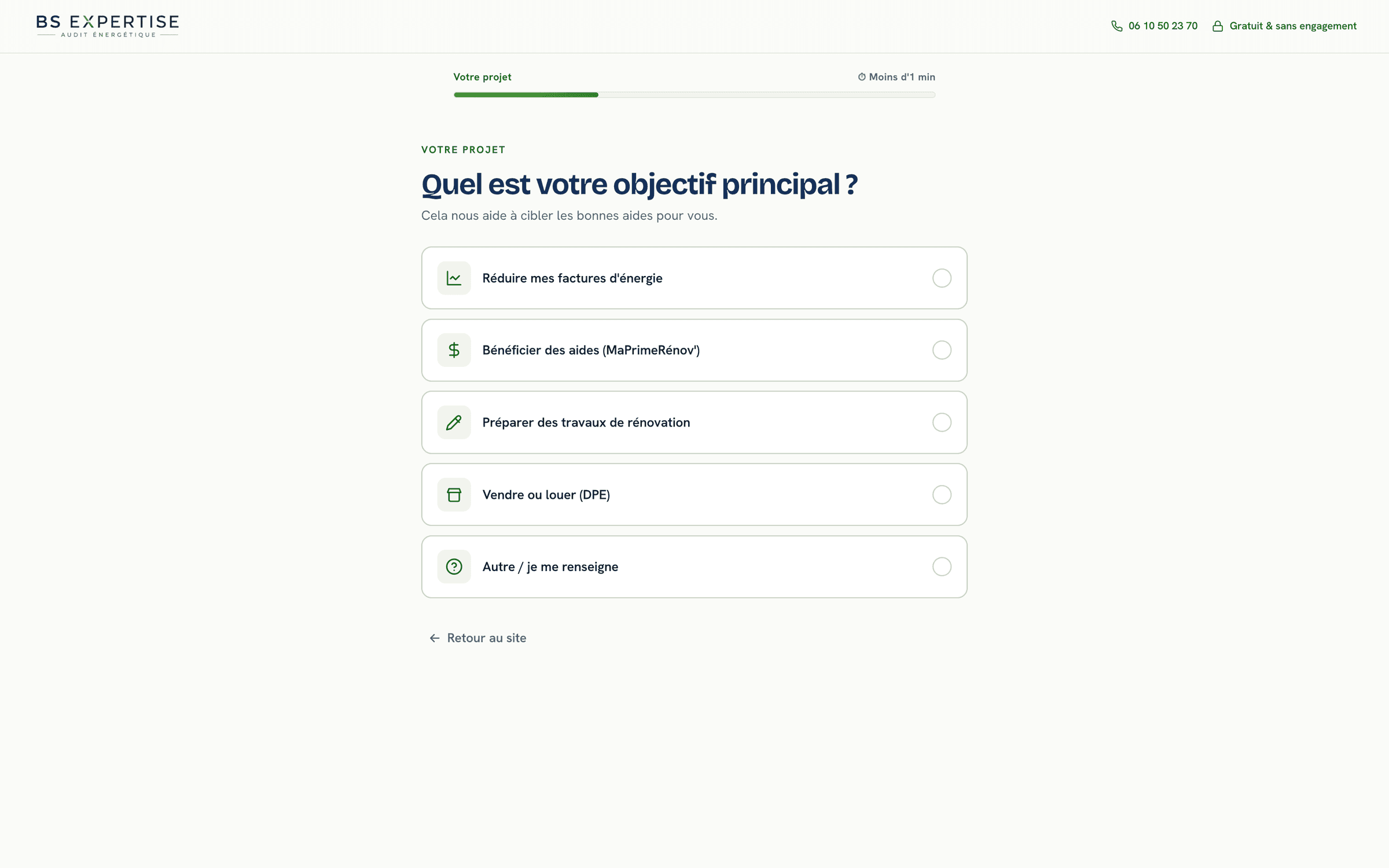
Seven questions, one per screen
Goal, property, floor area, year, heating, occupancy, town. Each screen asks a single question, with a progress bar and the time left. Contact details come last, once the effort has already been made.
Under the hood
Each step is validated on its own before the next one opens. The enquiry is written to the database before any email attempt: a mail outage no longer makes a prospect disappear.
On a phone
One question per screen, answers as full-width chips: the journey was designed thumb-first.
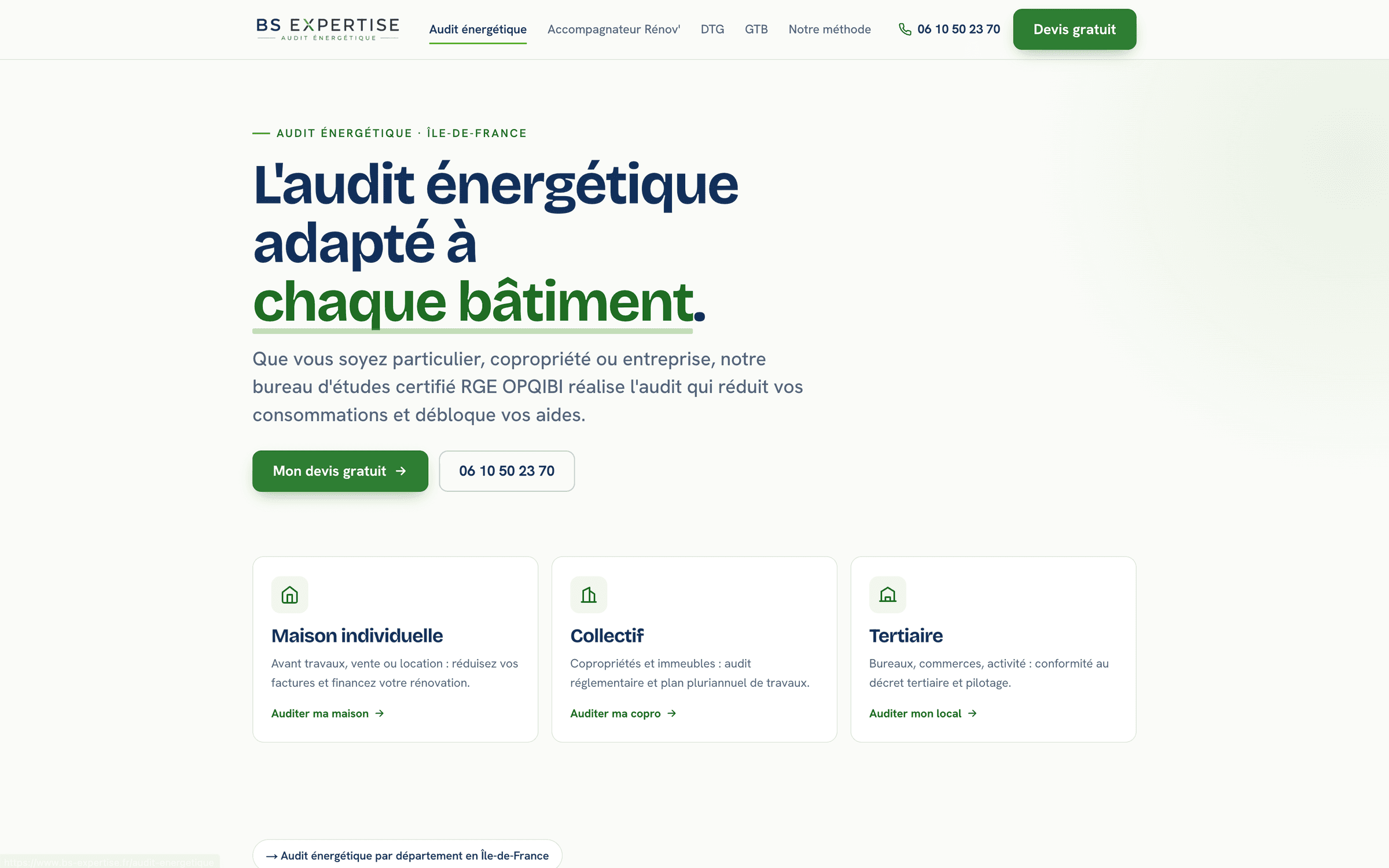
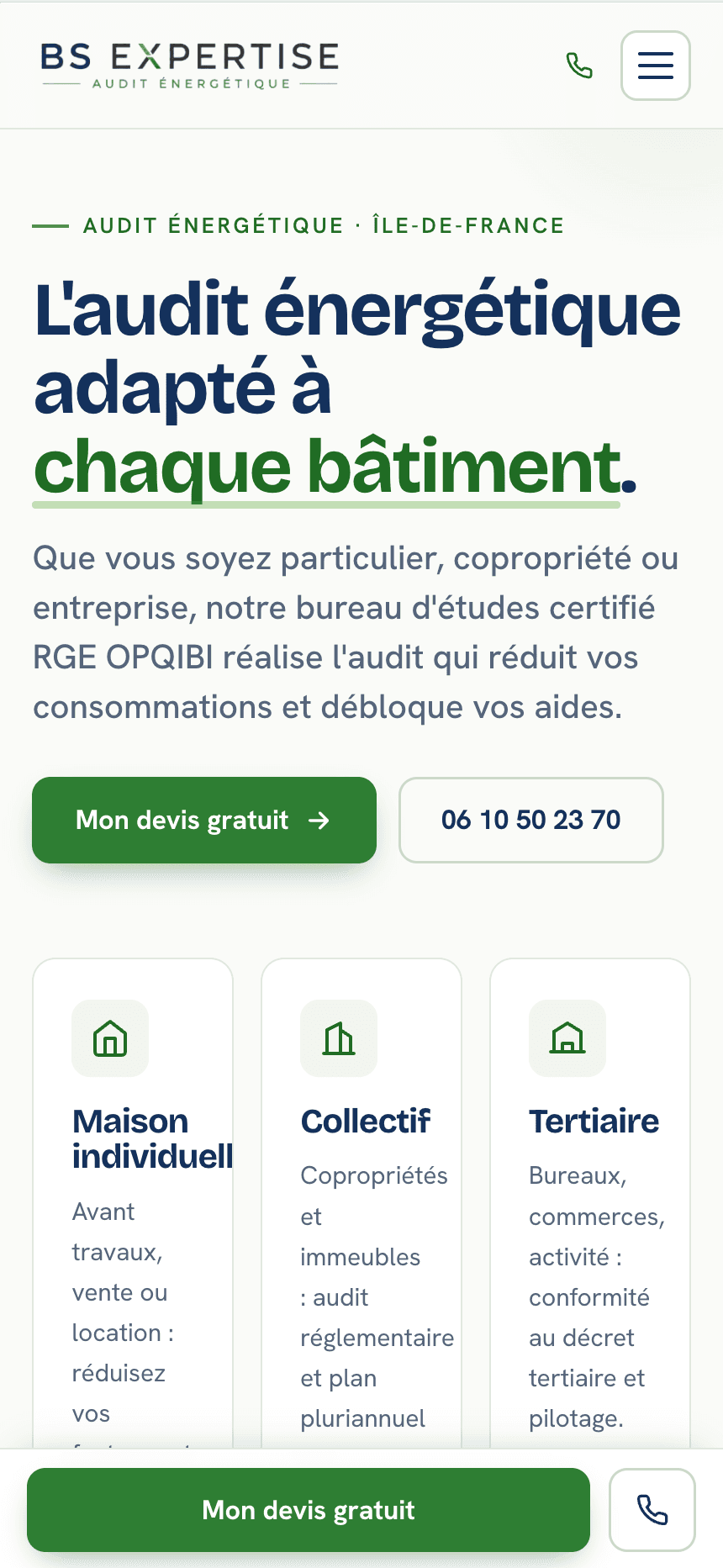
03 / 04
A page per building type
Single home, building association, commercial premises: three needs, three sets of regulations, three pages. And at the foot, the entry to the eight Île-de-France departments.
Under the hood
These pages are both indexable and built to convert, they're what the ads point to. No throwaway landing page hidden from search engines.
On a phone
The three cards stack without losing anything, and the quote button stays permanently reachable.
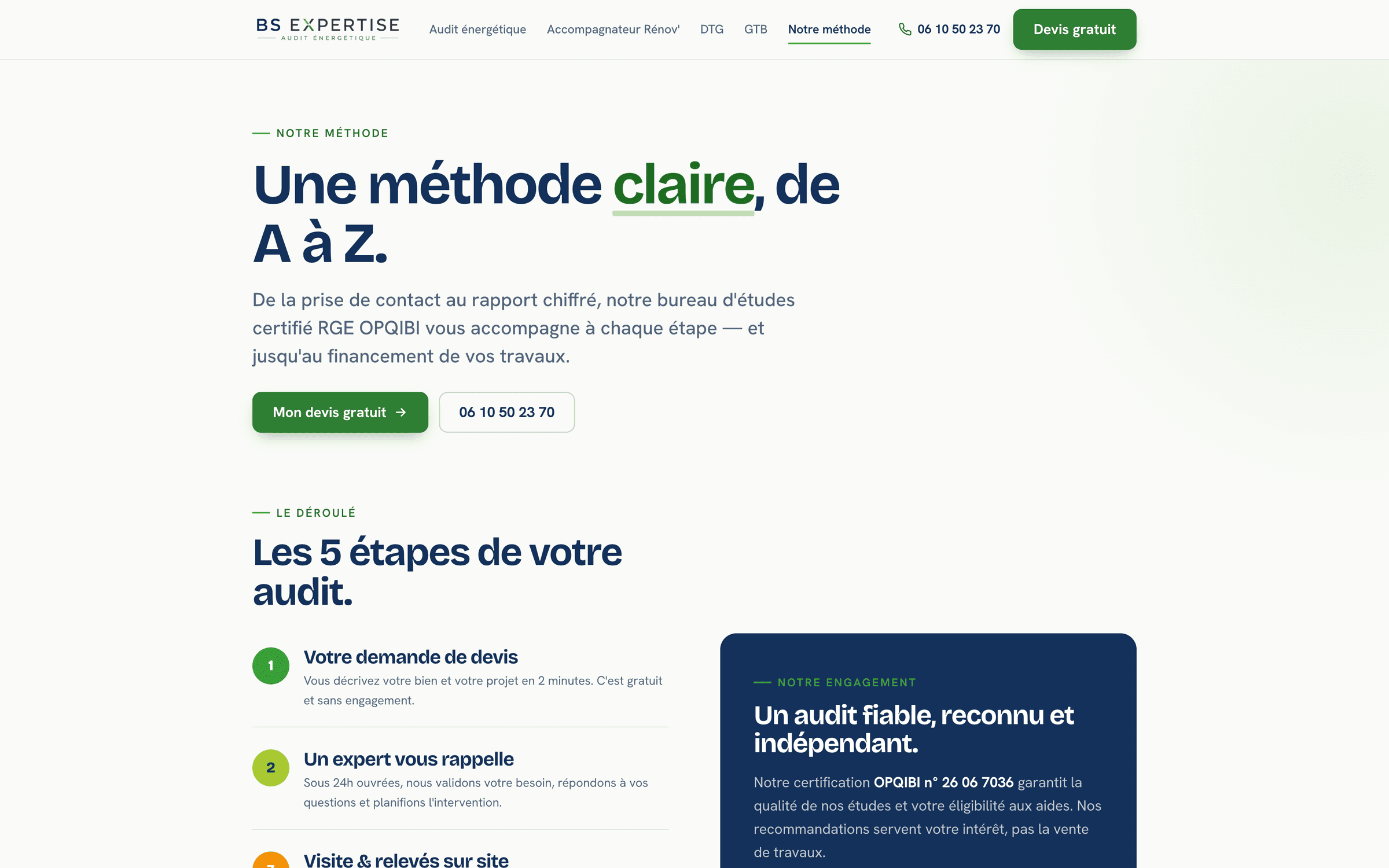

04 / 04
The process, before anyone asks
Five numbered steps, from enquiry to costed report, with the callback time stated. Opposite, the certification and its number: the promise and its proof on the same screen.
Under the hood
The pillar pages carry the organisation markup and its credential, which feeds the profile Google builds about the company.
On a phone
The process reads as a column, one step after another, which is its natural form anyway.
The same site, on a phone
Not a stripped-down version: the same pages, the same content, the same paths. Most visits come from a phone.
The decisions, and why
Each decision carries its reason, then what would break without it.
01
One page per department, or none
Each of the eight Île-de-France departments has its own page with genuinely different content. The rule was set from the start: no local page without material of its own.
Without it: Eight identical pages where only the department name changes is a satellite network, and Google spots it and penalises the whole site.
02
A funnel rather than a form
Seven short questions before the contact details, each validated at its own step. Commitment is asked for gradually, and along the way you get what's needed to price the job.
Without it: A fifteen-field form in one block drives people away. A three-field form gives you a contact you have to call back to ask everything again.
03
Consent to be called is proven, not assumed
French law of 30 June 2025 requires explicit consent before any commercial call. So we record the exact wording shown at the moment of the click, its version, the timestamp, the IP address and the browser. Enquiries predating this remain without proof: filling it in afterwards would be fabricating evidence.
Without it: A ticked box with no record of what was written next to it is worth nothing the day it's challenged.
04
Every enquiry knows where it came from
Source, medium, campaign, content, keyword, Google click identifier, landing page, referrer: all kept with the enquiry. You know which ad produced which appointment.
Without it: Without that chain you can neither cut a campaign that costs nor double down on one that pays. You steer on gut feel.
05
The site stands on its own
Pre-computed pages, the database reserved for enquiries. The enquiry is written to the database before any attempt to send an email, the order matters.
Without it: If the email goes first and the database fails, the lead exists in an inbox and nowhere else. If the email fails and nothing was written, it doesn't exist at all.
The advertising campaigns
The site is one thing, filling it is another. That part is run in-house too.
- The ads point to the site's own pages
- No throwaway landing page hidden from search engines. The service pages are both indexable and built to convert: every euro spent on ads advances a page that will later work for free.
- Targeting follows the real breakdown
- Campaigns are split the way the site is: by department and property type. An ad for a building association in Seine-Saint-Denis isn't the same as one for a house in Essonne, and doesn't land in the same place.
- Keywords are collected before they're chosen
- Search Console for the actual queries, positions and click-through rates; the analytics tool to see which pages convert. You start from what people type, not from what you imagine they type.
- Advertising buys the time that search takes to arrive
- Both target the same queries. Campaigns reveal within a week which keywords produce appointments; organic content is then written first for those winners. Paid is for learning, organic is for lasting.
- Conversions are measured cleanly
- The thank-you page carries the conversion event but stays out of search results, and campaign parameters don't create duplicate pages, each page declares its reference address without them.
- Enquiries are sorted where they arrive
- A back office lists enquiries with their commercial status and notes. No parallel spreadsheet, no re-typing: the enquiry, its advertising origin and its follow-up live in the same place.
- Our role
- Design, development, search, advertising campaigns
- Type
- Website
- Technologies
- Next.js 16
- TypeScript
- PostgreSQL (Neon)
- Drizzle ORM
- Resend
- Zod
- Vitest
Tell us what you are trying to build.
Message us on WhatsAppOther work
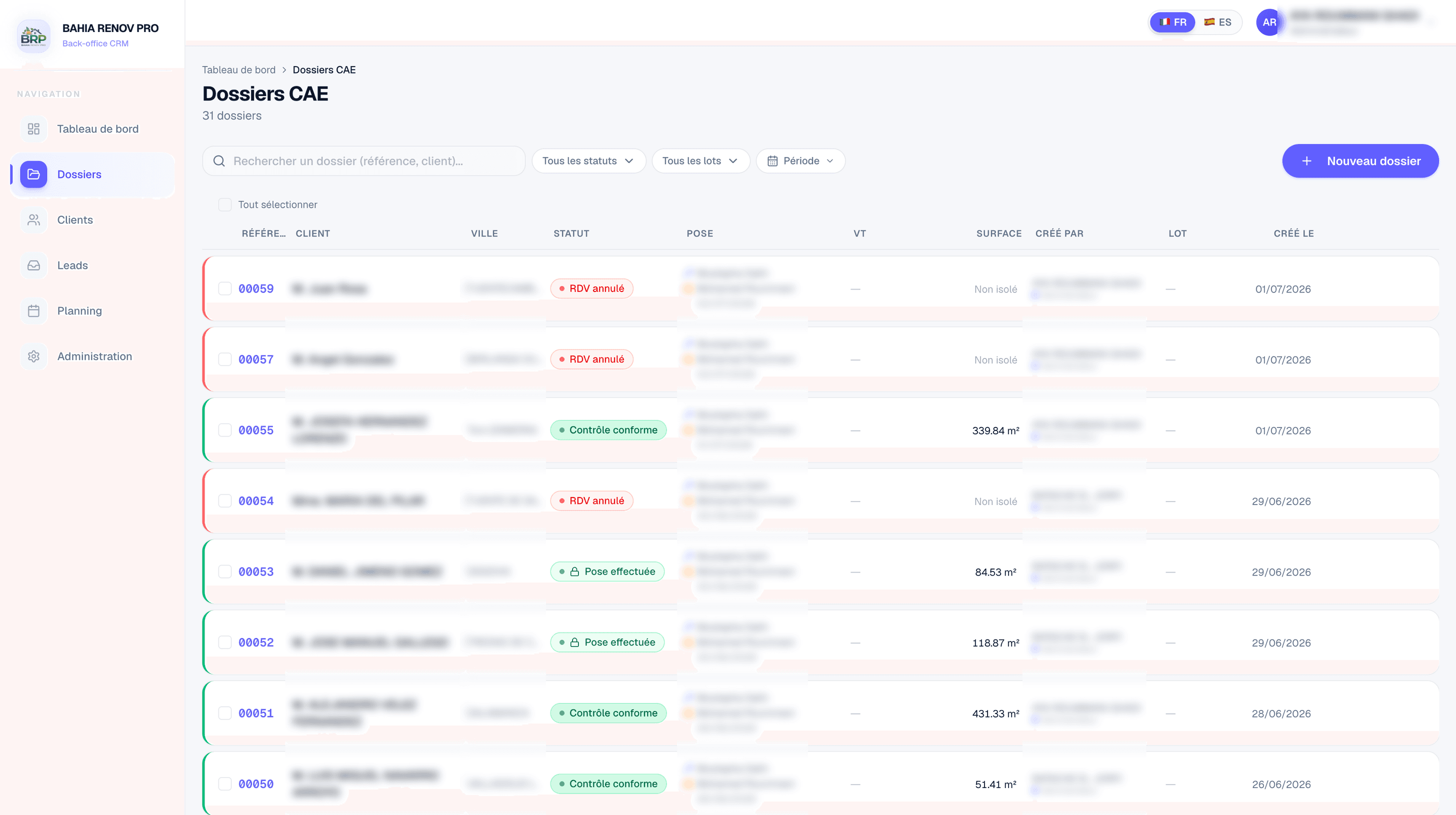
Bahia Renov Pro
Business software · Spain
Sites were run on a shared spreadsheet and the phone. Three people typed the same information, and every subsidy file had to reach the scheme operator with the right papers in the right order, or be rejected.
Read the case study
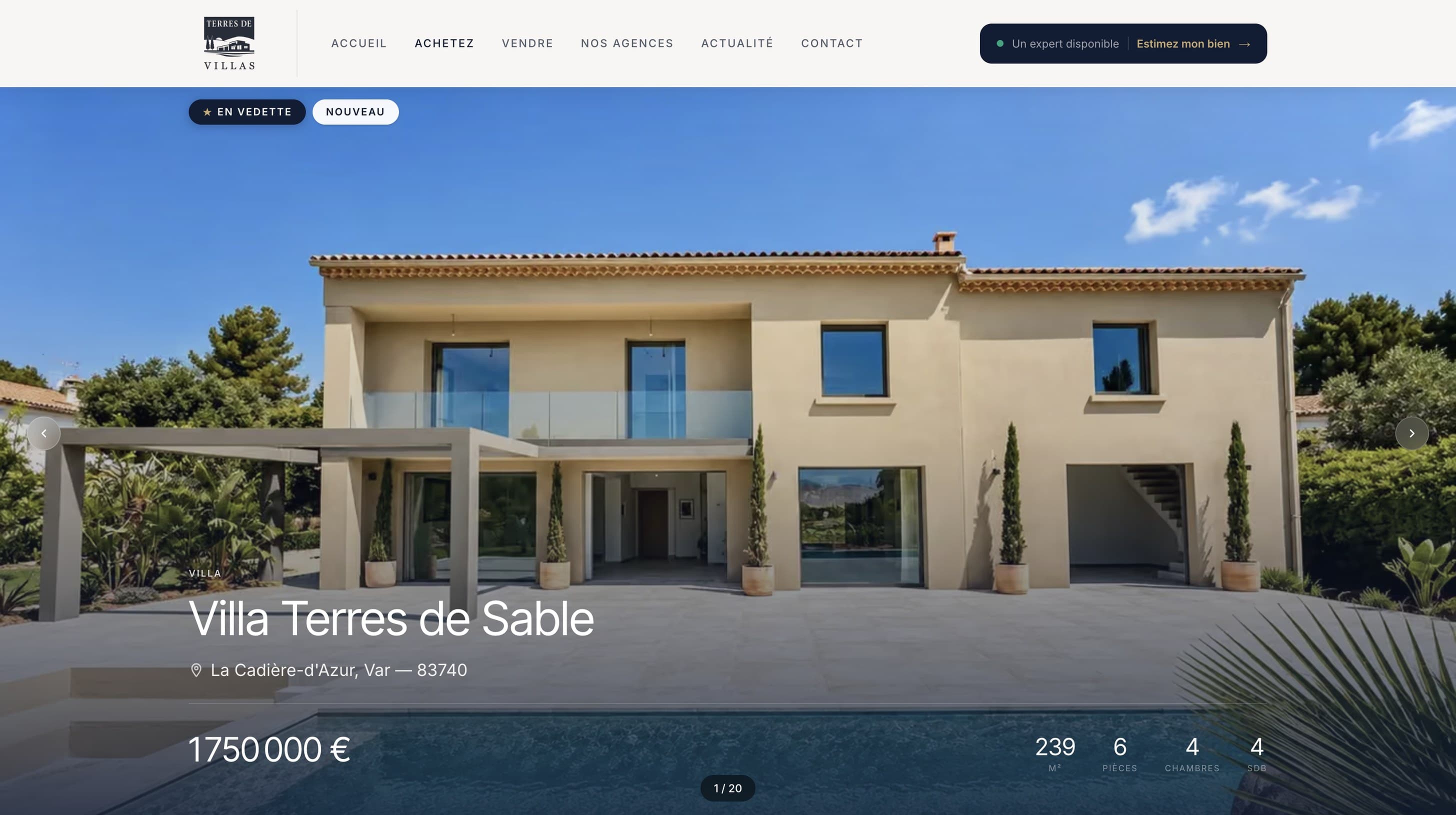
Terres de Villas
Luxury real estate · France
A young agency in a market where credibility is decided before the first appointment. Facing names established for twenty years, it had to look settled from day one, and exist in English without doubling the typing.
Read the case study
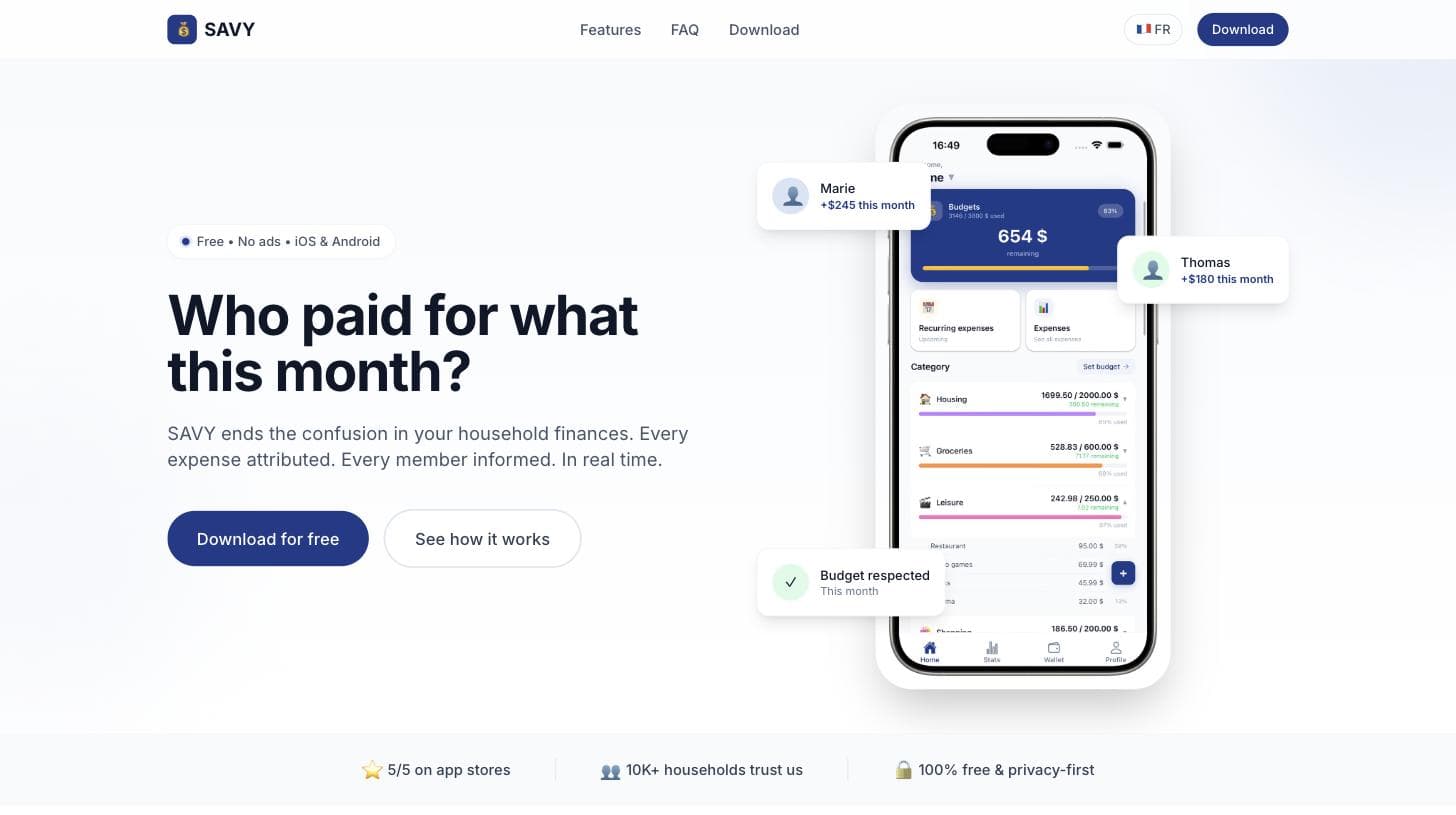
SAVY
Personal finance · Studio product
Keeping a budget together happens in a shared spreadsheet, or not at all. Someone fronts an expense, nobody knows where the month stands, and the conversation always comes back to the same place: who paid for what.
Read the case study